


Will the Most Important Person in the Room Raise Your Hand?

Some people mistakenly believe that more education or a higher title makes them more significant.

If you believe you’re the most important person in the room, go ahead and raise your hand.

It sounds almost humorous when you say it out loud. And yet, haven’t we all been in spaces where someone silently, or not so silently, seems to carry that very belief? I know I have.

Here’s the truth: no one in the room is more important than anyone else.

This reflection has been on my heart since a recent experience at a restaurant. I was enjoying a quiet meal when I witnessed a customer loudly ridicule a waitress because her glass of water didn’t have ice. What could have been a simple request turned into a humiliating scene. The customer belittled the waitress’s job and even suggested she “go to college” and “be somebody.”

My heart ached for that waitress. No one deserves to be diminished over something so trivial, and certainly not for earning an honest living.

Every person matters. Every job carries value.

Think about it. Without servers, how would we enjoy the experience of dining out? Without the countless individuals who serve in roles often overlooked, many of the comforts we take for granted would simply not exist.

Some people mistakenly believe that more education or a higher title makes them more significant. But significance is not measured by degrees or job descriptions. It is measured by character.

Consider the example of Jesus Christ. In John 13:14 (NIV), He says, “Now that I, your Lord and Teacher, have washed your feet, you also should wash one another’s feet.” He didn’t just speak about humility, He demonstrated it. He washed the feet of His disciples, of sinners, and even of Judas Iscariot, the very man who would later betray Him.

That act alone dismantles the idea that status determines worth.

If the One called Lord and Teacher could kneel in service, who are we to stand in superiority?

Today, let us choose gratitude over arrogance. Let us extend kindness instead of criticism. Let us remember that dignity belongs to everyone, whether they are leading a company, serving a meal, or quietly doing work the world rarely notices.

And the next time we find ourselves in a room full of people, may we remember: we are important, but so is everyone else.

Nurturing the Soul – Start Your Journey Toward Spiritual Growth

Life moves fast. Responsibilities pile up. Noise surrounds us. And somewhere along the way, our souls quietly ask for care.

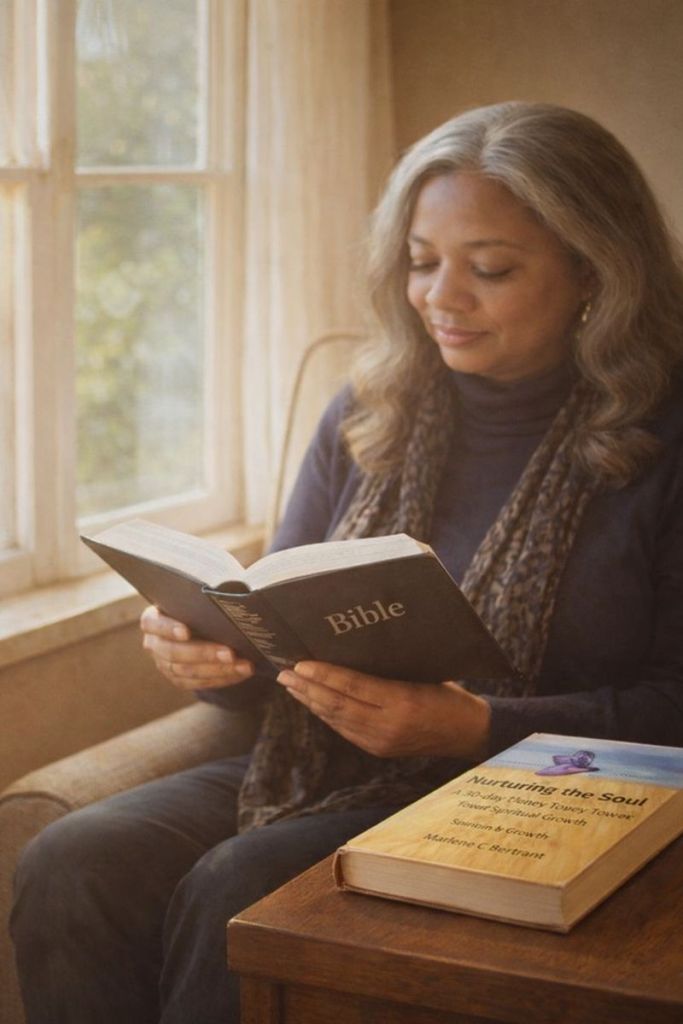
Marlene reading the bible.

In a world that constantly pulls at our attention, many of us feel spiritually tired, even when our faith is strong. Life moves fast. Responsibilities pile up. Noise surrounds us. And somewhere along the way, our souls quietly ask for care.

That is exactly why Nurturing the Soul: A 30-Day Journey Toward Spiritual Growth was written.

This book was created for people who desire a deeper connection with God but may feel overwhelmed, disconnected, or unsure where to begin. It is not about perfection. It is not about checking spiritual boxes. It is about creating intentional moments, small, meaningful pauses, to reconnect with God, reflect on life, and allow the soul to breathe again.

Why Nurturing the Soul Matters

We spend so much time nurturing others, our families, our careers, our communities, that we often neglect our inner life. Yet the soul needs care just as much as the body and mind. When the soul is neglected, it shows up as exhaustion, discouragement, and spiritual dryness.

Nurturing the Soul invites readers to slow down and return to the basics of faith: reflection, prayer, Scripture, and honest conversation with God. Each day of the 30-day journey is designed to gently guide the reader into deeper awareness, healing, and spiritual renewal.

This is not a book you rush through. It’s a book you sit with. A book you open each day as a sacred appointment with God.

What the 30-Day Journey Looks Like

Each day in Nurturing the Soul offers:

  • A focused spiritual theme
  • A carefully selected Bible verse
  • A devotional reflection meant to encourage, challenge, and uplift
  • Gentle prompts that invite personal reflection and prayer

The journey is structured, but flexible. Whether you are new to daily devotionals or returning after a long break, this book meets you exactly where you are.

Some days will feel comforting. Others may stir deep emotions. All of them are designed to help you grow spiritually, emotionally, and personally.

The Companion Journal: Going Deeper

Alongside the book is the Nurturing the Soul: 30-Day Companion Journal, created for those who want to go deeper in their reflection.

The journal is not an afterthought; it is an intentional extension of the journey. Writing has a powerful way of bringing clarity to thoughts, healing to emotions, and depth to prayer. The Companion Journal provides dedicated space to:

  • Respond to daily prompts
  • Record prayers and spiritual insights
  • Reflect honestly without judgment
  • Track growth over the 30-day journey

Many readers find that journaling transforms reading into an experience. It turns inspiration into action and reflection into lasting change.

Together, the book and journal create a sacred rhythm: read, reflect, write, pray, and grow.

Who This Journey Is For

Nurturing the Soul is for:

  • Anyone feeling spiritually weary or disconnected
  • Believers seeking renewal without pressure or guilt
  • Those navigating life transitions, grief, or uncertainty
  • Readers who desire a quieter, more intentional faith practice

You do not need to have all the answers. You simply need a willing heart.

An Invitation and How to Begin

If your soul has been longing for stillness, clarity, or renewed faith, this journey is for you.

Nurturing the Soul: A 30-Day Journey Toward Spiritual Growth and the accompanying 30-Day Companion Journal are both available on Amazon, making it easy to begin whenever you’re ready.

Simply visit Amazon, search for “Nurturing the Soul: A 30-Day Journey Toward Spiritual Growth,” and consider pairing it with the 30-Day Companion Journal for a richer, more transformative experience.

Your soul deserves care.
Your faith deserves time.
And your journey can begin today: one day at a time.

Morning Rhythms: Starting the Day with Peace and Purpose

How we start our day often shapes how it will end. When we begin with prayer and thanksgiving, we invite peace, hope, love, and joy to accompany us through every moment.

Have you ever noticed how the way you start your morning sets the tone for the rest of your day?


In this post, I share how beginning each morning with prayer, gratitude, and quiet time with God can transform your outlook and bring calm to even the busiest days.

Scripture Reading

Because of the Lord’s great love we are not consumed, for his compassions never fail. They are new every morning; great is your faithfulness.
— Lamentations 3:22–23 (NIV)

In the morning, Lord, you hear my voice; in the morning I lay my requests before you and wait expectantly.
— Psalm 5:3 (NIV)

Retrospection

Each morning, before my feet touch the floor, I take a few quiet moments to thank the Lord for the gift of a new day, another opportunity to live, to work, and to become more like the person He desires me to be. In those still moments, I lift my family and friends to Him. I offer my business dealings, my plans, and my concerns, asking God to stay at the center of everything I do.

When my time of prayer ends, I move on to the morning routine, which includes showering, drinking coffee, and preparing for the day ahead. Yet, before diving into tasks, I open my Bible. Reading His Word helps me align my thoughts with His will. I reflect on how I can apply His truth to my life so that others might see His light shining through me.

There was a time when I used to start my mornings differently. My first priority was checking emails, returning calls, and jumping into the day’s responsibilities. Only after I had worked through my to-do list did I turn my attention to God. But over time, I noticed a pattern; those days often felt rushed, unsettled, and incomplete.

Eventually, I discovered a profound truth: when I start my day with God, everything else unfolds with greater peace and purpose. Prayer and gratitude at the start of the day lay a foundation for wise decisions and calm perseverance. When I seek His guidance first, His blessings seem to accompany every step thereafter.

Time with God is essential to a life filled with hope and lasting peace. For some, mornings are the perfect time to meet with Him; for others, it may be during a quiet lunch break or in the stillness of the evening. The specific time is not what matters most. What matters is consistency and a heart open to His presence.

Each new morning symbolizes renewal. God’s mercies are fresh every day, and He listens to every word we speak. Knowing that, I want my first words to be to Him, words of gratitude, praise, and surrender.

Developing a habit of spending time with God daily transforms not only our mornings but our entire lives. How we start our day often shapes how it will end. When we begin with prayer and thanksgiving, we invite peace, hope, love, and joy to accompany us through every moment.

Application

Tomorrow morning, begin with five minutes of silence and gratitude. Whisper a simple prayer of thanks, invite God into your day, and let His presence guide every step you take.

Closing Prayer

Heavenly Father,
Thank You for the gift of a new morning and the promise of Your unfailing love. Help me to start each day by turning my heart toward You. Teach me to rest in Your peace before the world’s noise begins, and to carry Your presence with me through every task and conversation. May my mornings be filled with gratitude, my days with purpose, and my nights with peace.
In Jesus’ name, Amen.

Perspective: The Glass, the Case, and the Lesson We Forgot

Perspective. That’s what frames our opinions − whether we lean toward optimism or pessimism, whether we agree or disagree on an issue. Our experiences shape our viewpoints

Scripture Reading
“Do not judge according to appearance, but judge with righteous judgment.”
John 7:24 (NKJV)

I attended an event where the speaker projected a simple image onto the screen: a glass of water. Then came the familiar question: “Is the glass half full or half empty?”

Naturally, the audience was divided. Some saw the glass as half full, while others saw it as half empty.

It was a sales motivation conference, and the question was designed to reveal whether we tend to think positively or negatively. I answered, “Half full.” But then I realized something deeper: The question itself is rhetorical. The real answer depends on one key factor: your personal experience with the glass.

Think about it.
If the glass was empty when you first saw it and you poured in water halfway, you’d likely say it’s half full. But if the glass was once full and you poured out half the water, you’d probably say it’s half empty.

Perspective. That’s what frames our opinions − whether we lean toward optimism or pessimism, whether we agree or disagree on an issue. Our experiences shape our viewpoints.

It reminds me of something from debate class. Remember how we learned that every argument has two sides? Later, when I began studying law, my instructor made that lesson come alive. On the very first day, he divided the class into two groups − one to represent the plaintiff and the other, the defendant. We presented our cases and received our grades.

Then came the twist: He switched our roles. The plaintiff’s team now had to argue for the defense, and the defense had to represent the plaintiff. Our success depended on how well we could understand and defend a position we once opposed.

That exercise taught me one of the most valuable lessons of all: truth and understanding often live somewhere between both sides.
(As a side note, I didn’t finish law school − family obligations took precedence − but I still hold deep respect for that noble profession.)

What I want to convey today is this: Before judging others for seeing things differently, pause to consider their perspective. Life shapes each of us uniquely. The person beside you may have walked a path that led them to see the same “glass” in a completely different way.

We learned this lesson back in high school debate class, so how did we grow up and forget it?

Application

Before reacting to someone whose opinion differs from yours, take a moment to ask yourself, What might their experience have been? When we take time to understand the perspective behind a person’s belief, we often find empathy and even wisdom that we might have otherwise missed.

Reflection Question

When was the last time you took a moment to see a situation from someone else’s point of view? How might doing so change the way you respond?

Prayer

Heavenly Father,
Thank You for the reminder that perspective shapes how we see the world and one another. Teach me to listen with compassion and to respond with grace when opinions differ. Help me to remember that understanding begins where judgment ends. May I see others through the lens of love, just as You see me.
Amen.

Learning to Trust God’s Timing in Seasons of Waiting

God’s timing is not always ours. We may feel abandoned, but the truth is, He is preparing us for what’s ahead. Seasons of silence are not signs of rejection; they are times of preparation and growth.

Scripture Reading
“But they that wait upon the Lord shall renew their strength; they shall mount up with wings as eagles; they shall run, and not be weary; and they shall walk, and not faint.” – Isaiah 40:31 (NIV)

“To everything there is a season, and a time to every purpose under the heaven.” – Ecclesiastes 3:1 (NIV)

Reflection
Recently, I found myself walking through some of the lowest valleys of my life. At seventy years old, I thought I would have “found” myself by now; surely my purpose would be clear. Instead, I struggled with silence from heaven and the weight of unanswered questions.

I tried harder, worked longer, and sought to prove myself worthy of God’s attention. But instead of fulfillment, I felt emptier than ever. Then, as if silence weren’t enough, I began to lose loved ones, friendships, income, and even peace of mind. My life felt like it was unraveling thread by thread.

In that place of despair, I cried out one more time. Though I still didn’t hear an answer, God met me where I was. At church, during worship, the pastor prayed over me, and for the first time in a long time, I felt joy breaking through the hollow spaces of my heart. Later, a friend reminded me that this season of loss was preparation. God was not taking from me to punish me; He was making room for where He was leading me.

That reminder brought me back to Scripture: to everything there is a season. When we wait on the Lord, even in silence, He promises to renew our strength and lift us on eagle’s wings.

Application
God’s timing is not always ours. We may feel abandoned, but the truth is, He is preparing us for what’s ahead. Seasons of silence are not signs of rejection; they are times of preparation and growth.

Reflection Question
Have you ever felt like God was silent and doubted His timing? How might God be preparing you in this very season?

Prayer
Father, thank You for reminding me that Your timing is perfect, even when I don’t understand it. Help me trust You in the silence, and strengthen me to wait on You with hope. Renew my spirit so that I may walk faithfully into the season You are preparing for me. Amen.