

Will the Most Important Person in the Room Raise Your Hand?

Some people mistakenly believe that more education or a higher title makes them more significant.

If you believe you’re the most important person in the room, go ahead and raise your hand.

It sounds almost humorous when you say it out loud. And yet, haven’t we all been in spaces where someone silently, or not so silently, seems to carry that very belief? I know I have.

Here’s the truth: no one in the room is more important than anyone else.

This reflection has been on my heart since a recent experience at a restaurant. I was enjoying a quiet meal when I witnessed a customer loudly ridicule a waitress because her glass of water didn’t have ice. What could have been a simple request turned into a humiliating scene. The customer belittled the waitress’s job and even suggested she “go to college” and “be somebody.”

My heart ached for that waitress. No one deserves to be diminished over something so trivial, and certainly not for earning an honest living.

Every person matters. Every job carries value.

Think about it. Without servers, how would we enjoy the experience of dining out? Without the countless individuals who serve in roles often overlooked, many of the comforts we take for granted would simply not exist.

Some people mistakenly believe that more education or a higher title makes them more significant. But significance is not measured by degrees or job descriptions. It is measured by character.

Consider the example of Jesus Christ. In John 13:14 (NIV), He says, “Now that I, your Lord and Teacher, have washed your feet, you also should wash one another’s feet.” He didn’t just speak about humility, He demonstrated it. He washed the feet of His disciples, of sinners, and even of Judas Iscariot, the very man who would later betray Him.

That act alone dismantles the idea that status determines worth.

If the One called Lord and Teacher could kneel in service, who are we to stand in superiority?

Today, let us choose gratitude over arrogance. Let us extend kindness instead of criticism. Let us remember that dignity belongs to everyone, whether they are leading a company, serving a meal, or quietly doing work the world rarely notices.

And the next time we find ourselves in a room full of people, may we remember: we are important, but so is everyone else.
Nurturing the Soul – Start Your Journey Toward Spiritual Growth

Life moves fast. Responsibilities pile up. Noise surrounds us. And somewhere along the way, our souls quietly ask for care.

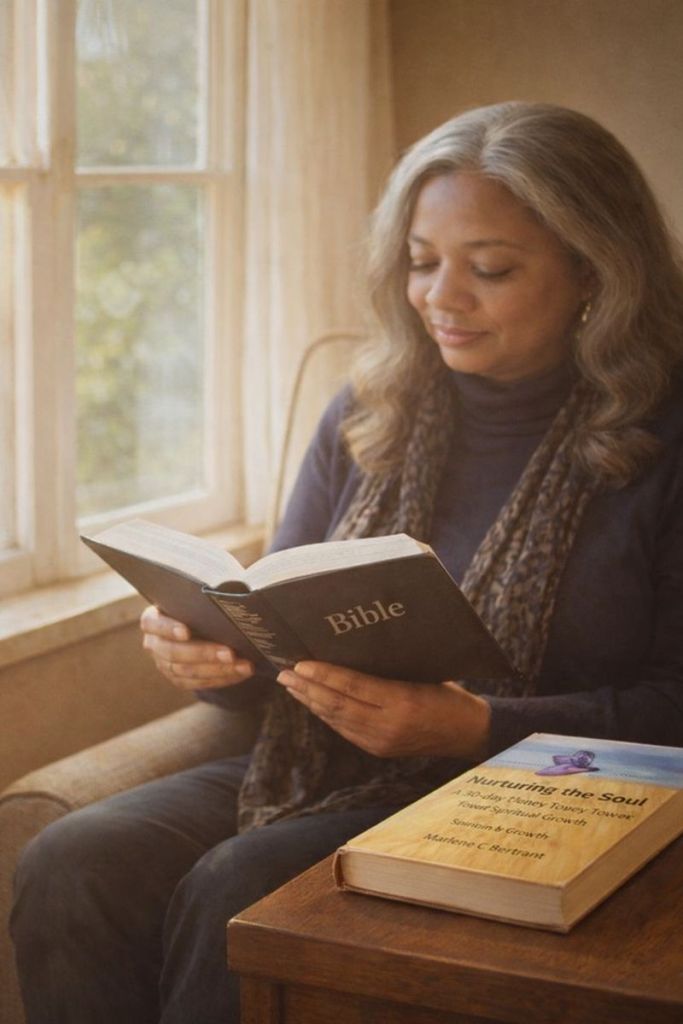
Marlene reading the bible.

In a world that constantly pulls at our attention, many of us feel spiritually tired, even when our faith is strong. Life moves fast. Responsibilities pile up. Noise surrounds us. And somewhere along the way, our souls quietly ask for care.

That is exactly why Nurturing the Soul: A 30-Day Journey Toward Spiritual Growth was written.

This book was created for people who desire a deeper connection with God but may feel overwhelmed, disconnected, or unsure where to begin. It is not about perfection. It is not about checking spiritual boxes. It is about creating intentional moments, small, meaningful pauses, to reconnect with God, reflect on life, and allow the soul to breathe again.

Why Nurturing the Soul Matters

We spend so much time nurturing others, our families, our careers, our communities, that we often neglect our inner life. Yet the soul needs care just as much as the body and mind. When the soul is neglected, it shows up as exhaustion, discouragement, and spiritual dryness.

Nurturing the Soul invites readers to slow down and return to the basics of faith: reflection, prayer, Scripture, and honest conversation with God. Each day of the 30-day journey is designed to gently guide the reader into deeper awareness, healing, and spiritual renewal.

This is not a book you rush through. It’s a book you sit with. A book you open each day as a sacred appointment with God.

What the 30-Day Journey Looks Like

Each day in Nurturing the Soul offers:

  • A focused spiritual theme
  • A carefully selected Bible verse
  • A devotional reflection meant to encourage, challenge, and uplift
  • Gentle prompts that invite personal reflection and prayer

The journey is structured, but flexible. Whether you are new to daily devotionals or returning after a long break, this book meets you exactly where you are.

Some days will feel comforting. Others may stir deep emotions. All of them are designed to help you grow spiritually, emotionally, and personally.

The Companion Journal: Going Deeper

Alongside the book is the Nurturing the Soul: 30-Day Companion Journal, created for those who want to go deeper in their reflection.

The journal is not an afterthought; it is an intentional extension of the journey. Writing has a powerful way of bringing clarity to thoughts, healing to emotions, and depth to prayer. The Companion Journal provides dedicated space to:

  • Respond to daily prompts
  • Record prayers and spiritual insights
  • Reflect honestly without judgment
  • Track growth over the 30-day journey

Many readers find that journaling transforms reading into an experience. It turns inspiration into action and reflection into lasting change.

Together, the book and journal create a sacred rhythm: read, reflect, write, pray, and grow.

Who This Journey Is For

Nurturing the Soul is for:

  • Anyone feeling spiritually weary or disconnected
  • Believers seeking renewal without pressure or guilt
  • Those navigating life transitions, grief, or uncertainty
  • Readers who desire a quieter, more intentional faith practice

You do not need to have all the answers. You simply need a willing heart.

An Invitation and How to Begin

If your soul has been longing for stillness, clarity, or renewed faith, this journey is for you.

Nurturing the Soul: A 30-Day Journey Toward Spiritual Growth and the accompanying 30-Day Companion Journal are both available on Amazon, making it easy to begin whenever you’re ready.

Simply visit Amazon, search for “Nurturing the Soul: A 30-Day Journey Toward Spiritual Growth,” and consider pairing it with the 30-Day Companion Journal for a richer, more transformative experience.

Your soul deserves care.
Your faith deserves time.
And your journey can begin today: one day at a time.

This World is Not Our Final Home

We are not meant to find our peace or fulfillment in this broken world. The hurt we experience here is temporary, no matter how deep it feels.

Everywhere we look today, it feels like the world is unraveling. People lash out in anger, friendships are torn apart, and love seems to grow colder by the day. It’s heartbreaking to witness how easily kindness is forgotten and how often relationships are sacrificed over pride, selfishness, or misunderstanding. 

For those who are on the receiving end of pain, betrayal, rejection, or cruelty, it’s natural to feel the urge to fight back, to retaliate, to defend your heart. But God’s Word calls us to something higher. Hebrews 13:14 (NLT) reminds us, “For this world is not our permanent home; we are looking forward to a home yet to come.” This truth gives us the strength to respond differently. 

We are not meant to find our peace or fulfillment in this broken world. The hurt we experience here is temporary, no matter how deep it feels. Our citizenship is not of this earth; Philippians 3:20 (NLT) declares, “But we are citizens of heaven, where the Lord Jesus Christ lives. And we are eagerly waiting for him to return as our Savior.”

When we remember that heaven is our true home, we gain perspective. The pain others inflict doesn’t define us; it refines us. Every trial becomes an opportunity to draw closer to Christ, to model His grace, and to reflect His light in the darkness. 

So, when you feel like the world is falling apart around you, take heart. God sees your tears. He knows your hurt. And He promises that one day, all wrongs will be made right. Until then, walk in peace, love without fear, and keep your eyes fixed on the home that awaits you, where there will be no more sorrow, no more betrayal, and no more pain. 

Heaven is our final destination. Let’s live each day with that hope in our hearts. 

Related Song: This World Is Falling Apart

For anyone who has been hurt by the players in this world, remember, this world may be harsh, but we have heaven to look forward to. Please click to hear the song and video inspired by Hebrews 13:14 and Philippians 3:20.

Perspective: The Glass, the Case, and the Lesson We Forgot

Perspective. That’s what frames our opinions − whether we lean toward optimism or pessimism, whether we agree or disagree on an issue. Our experiences shape our viewpoints

Scripture Reading
“Do not judge according to appearance, but judge with righteous judgment.”
John 7:24 (NKJV)

I attended an event where the speaker projected a simple image onto the screen: a glass of water. Then came the familiar question: “Is the glass half full or half empty?”

Naturally, the audience was divided. Some saw the glass as half full, while others saw it as half empty.

It was a sales motivation conference, and the question was designed to reveal whether we tend to think positively or negatively. I answered, “Half full.” But then I realized something deeper: The question itself is rhetorical. The real answer depends on one key factor: your personal experience with the glass.

Think about it.
If the glass was empty when you first saw it and you poured in water halfway, you’d likely say it’s half full. But if the glass was once full and you poured out half the water, you’d probably say it’s half empty.

Perspective. That’s what frames our opinions − whether we lean toward optimism or pessimism, whether we agree or disagree on an issue. Our experiences shape our viewpoints.

It reminds me of something from debate class. Remember how we learned that every argument has two sides? Later, when I began studying law, my instructor made that lesson come alive. On the very first day, he divided the class into two groups − one to represent the plaintiff and the other, the defendant. We presented our cases and received our grades.

Then came the twist: He switched our roles. The plaintiff’s team now had to argue for the defense, and the defense had to represent the plaintiff. Our success depended on how well we could understand and defend a position we once opposed.

That exercise taught me one of the most valuable lessons of all: truth and understanding often live somewhere between both sides.
(As a side note, I didn’t finish law school − family obligations took precedence − but I still hold deep respect for that noble profession.)

What I want to convey today is this: Before judging others for seeing things differently, pause to consider their perspective. Life shapes each of us uniquely. The person beside you may have walked a path that led them to see the same “glass” in a completely different way.

We learned this lesson back in high school debate class, so how did we grow up and forget it?

Application

Before reacting to someone whose opinion differs from yours, take a moment to ask yourself, What might their experience have been? When we take time to understand the perspective behind a person’s belief, we often find empathy and even wisdom that we might have otherwise missed.

Reflection Question

When was the last time you took a moment to see a situation from someone else’s point of view? How might doing so change the way you respond?

Prayer

Heavenly Father,
Thank You for the reminder that perspective shapes how we see the world and one another. Teach me to listen with compassion and to respond with grace when opinions differ. Help me to remember that understanding begins where judgment ends. May I see others through the lens of love, just as You see me.
Amen.

Learning to Trust God’s Timing in Seasons of Waiting

God’s timing is not always ours. We may feel abandoned, but the truth is, He is preparing us for what’s ahead. Seasons of silence are not signs of rejection; they are times of preparation and growth.

Scripture Reading
“But they that wait upon the Lord shall renew their strength; they shall mount up with wings as eagles; they shall run, and not be weary; and they shall walk, and not faint.” – Isaiah 40:31 (NIV)

“To everything there is a season, and a time to every purpose under the heaven.” – Ecclesiastes 3:1 (NIV)

Reflection
Recently, I found myself walking through some of the lowest valleys of my life. At seventy years old, I thought I would have “found” myself by now; surely my purpose would be clear. Instead, I struggled with silence from heaven and the weight of unanswered questions.

I tried harder, worked longer, and sought to prove myself worthy of God’s attention. But instead of fulfillment, I felt emptier than ever. Then, as if silence weren’t enough, I began to lose loved ones, friendships, income, and even peace of mind. My life felt like it was unraveling thread by thread.

In that place of despair, I cried out one more time. Though I still didn’t hear an answer, God met me where I was. At church, during worship, the pastor prayed over me, and for the first time in a long time, I felt joy breaking through the hollow spaces of my heart. Later, a friend reminded me that this season of loss was preparation. God was not taking from me to punish me; He was making room for where He was leading me.

That reminder brought me back to Scripture: to everything there is a season. When we wait on the Lord, even in silence, He promises to renew our strength and lift us on eagle’s wings.

Application
God’s timing is not always ours. We may feel abandoned, but the truth is, He is preparing us for what’s ahead. Seasons of silence are not signs of rejection; they are times of preparation and growth.

Reflection Question
Have you ever felt like God was silent and doubted His timing? How might God be preparing you in this very season?

Prayer
Father, thank You for reminding me that Your timing is perfect, even when I don’t understand it. Help me trust You in the silence, and strengthen me to wait on You with hope. Renew my spirit so that I may walk faithfully into the season You are preparing for me. Amen.

The Power of Gratitude: Finding Joy in Everyday Blessings

Have you ever noticed how easy it is to focus on what’s missing in life? Gratitude has a way of shifting our eyes away from what we lack and fixing them on what God provides.

Have you ever noticed how easy it is to focus on what’s missing in life? The goals we haven’t yet reached, the resources we wish we had, or the problems that seem too big to solve. Gratitude has a way of shifting our eyes away from what we lack and fixing them on what God provides. When we choose thankfulness, our perspective changes, and so does our heart.

There was a time I lived without gratitude for the wonderful lifestyle I had. During this time, I lived in one of the largest houses in the neighborhood. It was a five-bedroom, three-bathroom, 2500-square-foot house with a large yard and other fine amenities. Still, I would see houses in what I perceived were more prestigious neighborhoods and wish I had one of those houses.

One day, all that I had was lost. My husband and I lost our jobs on the same day due to what companies were calling at the time, “right-sizing.” The result of this situation is that we suddenly had no income. We ended up losing the house and had to move into a small rental house until we could find jobs and buy a home again. This time, the house we purchased was in what I considered a less prestigious neighborhood. But I was happy and proud of my little house. As I look back at what I used to have, I realize I had more than enough. In fact, I had more than most people could ever imagine having.

It took losing everything to begin to appreciate the little things. I love my new life, and I am grateful for everything God gives me, no matter how small.

Gratitude trains our hearts to see God’s daily goodness.
The truth is, God shows up in our lives every single day. Sometimes it’s in the big, undeniable moments, and other times it’s in the small details: a warm smile from a friend, the beauty of a sunrise, or the peace that comes with prayer. Gratitude opens our eyes to these blessings, reminding us that God’s faithfulness isn’t occasional, it’s constant.

Joy grows when we thank God for even the smallest moments.
The Bible says, in 1 Thessalonians 5:16-18 (NIV), Rejoice always, pray continually, give thanks in all circumstances; for this is God’s will for you in Christ Jesus. Joy isn’t found in perfect conditions but in a heart that chooses to give thanks. When we pause to thank God for the little things, we cultivate joy that no trial can steal. Gratitude is like watering a garden. The more we pour into it, the more it blossoms.

Gratitude draws us closer to peace.
When anxiety and worry press in, gratitude is the antidote. Philippians 4:6-7 (NIV) tells us, Do not be anxious about anything, but in every situation, by prayer and petition, with thanksgiving, present your requests to God. The promise is clear: thanksgiving leads to peace. Gratitude is not just a nice thought; it’s a spiritual practice that connects us to the calm assurance that God is in control.

A Closing Nudge
What if you began today with a simple gratitude list? Write down three small things you thank God for right now. It could be the breath in your lungs, the meal you just enjoyed, or the presence of a loved one. As you make gratitude a habit, you’ll begin to see how God is weaving goodness into every part of your life story.

What It Means to Live Authentically Through God’s Eyes

Living authentically is about walking in truth. It means letting go of the pressures of the world, the opinions of others, and the weight of expectations that don’t belong to us.

Live authentically through God's eyes.

From the time I can remember, I have felt a deep calling to teach, to encourage, and to help others discover who they truly are in Christ. Recently, that calling took on a new dimension when I completed an intensive program to become a Certified Authenticity Life Coach.

On my very first day of certification, I met with a woman who faced a struggle many of us can relate to, choosing between pleasing others and honoring her own God-given path. She has a servant’s heart, always eager to help, but this time she was torn. Someone wanted her to take on a responsibility that didn’t align with her true calling, and she felt pressured. Her heart said no, but her fear of disappointing others said yes.

That moment reminded me of the truth found in Psalm 139:13 (NKJV):
“For You formed my inward parts; You covered me in my mother’s womb.”

God did not create us by accident. He carefully designed every part of who we are, our bodies, our personalities, our emotions, and even our unique ways of serving others. When we ignore that divine design and allow others to push us away from our true purpose, we step out of alignment with the life God created us to live.

The Holy Spirit whispers to each of us, guiding us toward the purpose that brings glory to God and fulfillment to our souls. Your talents, your passions, and your voice are not random; they are gifts meant to be used authentically.

Jesus said in John 8:32 (NKJV):
“And you shall know the truth, and the truth shall make you free.”

Living authentically is about walking in that truth. It means letting go of the pressures of the world, the opinions of others, and the weight of expectations that don’t belong to us. Instead, we anchor ourselves in the promises of God.

When we choose to “seek first the kingdom of God and His righteousness” as we are reminded in Matthew 6:33 (NKJV):
“But seek first the kingdom of God and His righteousness, and all these things shall be added to you.”

…we find a freedom this world cannot give. We discover peace, joy, and fulfillment, not because life is perfect, but because our hearts are aligned with God’s will.

To live authentically through God’s eyes is to live in truth. It’s to accept that He made us intentionally. We are to love ourselves as His creation, and boldly walk in the path He has prepared.

When we do this, life becomes lighter. Our service becomes more meaningful. And our joy? It overflows.

Reflection

Ask yourself today: Am I living the life God designed for me, or am I letting the expectations of others pull me away from His purpose? Remember, authenticity in Christ is not selfish; it is obedience. When you embrace the person God created you to be, you not only walk in freedom, but you also bless others with the unique gifts only you can give.

Prayer

Heavenly Father,
Thank You for creating me with intention and love. Help me to hear Your voice above all others and to walk boldly in the path You have prepared for me. Teach me to live authentically, seeking Your Kingdom first, and trusting that everything I need will be added in Your perfect timing. May my life be a reflection of Your truth and grace.
In Jesus’ name, Amen.

Forgiving Ourselves: Embracing Who We Are Today

Forgiveness doesn’t mean excusing what happened or pretending it didn’t matter. It means choosing not to keep punishing yourself for something you cannot change.

A sunrise notes the beginning of the day.

One of the hardest things we face in life is learning to forgive ourselves. Mistakes, regrets, and wrong turns are part of every human journey, yet many of us struggle with letting go of our past. Sometimes, it feels even harder because people around us keep reminding us of who we used to be. They may only see the version of us who made those mistakes, not the person we’ve worked hard to become.

But here’s the truth: who you are now matters far more than who you were then.

The Weight of the Past

We all have moments we wish we could erase. Words we wish we hadn’t spoken. Decisions we wish we hadn’t made. For some, those memories replay in our minds like a never-ending film. Add to that the voices of people who refuse to let us move forward, and it can feel impossible to break free from the weight of yesterday.

But holding on to the past doesn’t change it. All it does is rob us of peace in the present.

Shifting the Perspective

The real question isn’t, “What mistakes did I make?” The real question is, “Who have I become because of them?” Every wrong step teaches us something. Every stumble strengthens us. Every regret sharpens our awareness. Growth often comes from the very things we wish had never happened.

If others can’t see your growth, that’s their limitation, not yours. You are not obligated to remain chained to the version of yourself that no longer exists.

Letting Go of Self-Blame

Forgiveness doesn’t mean excusing what happened or pretending it didn’t matter. It means choosing not to keep punishing yourself for something you cannot change.

Think about it this way:

  • Would you hold someone else’s worst day against them forever?
  • Would you deny someone else the chance to grow, heal, and change?

If not, then why deny yourself that same grace?

Walking Forward in Freedom

Every sunrise brings a chance to live differently, to make better choices, and to create a story that reflects the best of who you are today. Don’t let the echoes of your past drown out the voice of your present.

So stop beating yourself up. Stop rehearsing the old stories. Stop agreeing with people who only want to define you by yesterday’s chapters.

You’ve grown. You’ve learned. You’ve changed.

And that’s what matters most.

“You Do You” and Other Left-Handed Compliments

Left-handed compliments are passive-aggressive. They’re sly. And they often leave you wondering, was that supposed to be nice?

Since publishing my book Transformation, I’ve been on a personal mission, one that’s both exciting and a little terrifying, to become the most authentic version of myself. I’ve been journaling the journey, collecting the lessons, and slowly shaping them into my next book, Nurturing the Soul. My hope is that it will one day serve as a gentle light for others walking their own path toward self-acceptance.

The very first step? Deciding I was done pretending.

For years, I wore a mask so seamlessly that even I forgot it was there. I smiled, I served, I poured myself out for others, so much so that I started losing sight of the person underneath the performance. Don’t get me wrong, I value kindness and service deeply. But somewhere along the way, “serving” others became a cover for something else: a fear of letting people down. And when you fear disappointing others, you learn to swallow your own needs… and sometimes even swallow insults.

One type of insult I’ve swallowed more times than I can count is what’s known as the left-handed compliment.

What’s a Left-handed Compliment?

Also called a “backhanded compliment,” it’s a remark that sounds like praise on the surface but is wrapped around a little barb of criticism. It’s a way of smiling at you while simultaneously poking you in the ribs.

It’s passive-aggressive. It’s sly. And it often leaves you wondering, was that supposed to be nice?

The truth is, these kinds of comments are less about lifting you up and more about putting you in your place. And while they might seem harmless to the speaker, they can sting, especially if you’re used to brushing things off in the name of keeping the peace.

So, let’s talk examples.

10 Examples of Left-handed Compliments

  1. “You do you.”
    Translation: I think your choice is weird, but hey, if you want to be wrong, that’s on you.
  2. “Wow, you look great… for your age.”
    Translation: You look good, but let’s not forget you’re no spring chicken.
  3. “I could never pull that off, but it works for you.”
    Translation: That outfit is questionable, but somehow you manage to survive it.
  4. “You’re so brave to wear something like that.”
    Translation: I would never wear that because I think it’s awful.
  5. “You’re actually pretty good at this.”
    Translation: I assumed you’d be terrible, but you’ve exceeded my low expectations.
  6. “That haircut makes you look… different.”
    Translation: I don’t like it, but I’ll pretend I’m neutral.
  7. “You look so much better than you used to.”
    Translation: You were a mess before.
  8. “You’re so confident!”
    Translation: I wouldn’t have the nerve to do what you’re doing, because it’s risky (or silly).
  9. “I wish I had the freedom to dress like you do.”
    Translation: You clearly don’t care what people think, and maybe you should.
  10. “You’re surprisingly articulate.”
    Translation: I didn’t expect you to sound intelligent.

Nurture Your Soul

Learning to spot these backhanded compliments has been one of the most freeing parts of my journey. They no longer slip by unnoticed. And more importantly, I no longer feel the need to laugh them off to avoid making things awkward.

Peeling off the mask isn’t just about being honest with others; it’s about being honest with yourself when something doesn’t feel right.

The more I practice this, the more I realize that nurturing the soul sometimes means pruning away the voices that don’t feed it. And I think that’s a compliment worth giving… and receiving.