Protect your heart. Not everyone deserves access to your inner world.
Just because people want to be in your world doesn’t mean you need to give them access. Your world is sacred. And if you want peace in your life, you must be intentional about who gets close to you.
It took me a long time to accept that not everyone gets to be my friend. I learned that lesson through deep hurt from someone I once believed was a lifelong friend. Because we disagreed politically, she said things that made me feel less than human. Her words cut deeply. I cried for days, questioning myself, my character, and my worth. My heart felt shattered.
Then one day, my husband said to me, “Marlene, you’re the nicest person I know. Not everybody gets to be your friend.” And he walked away.
That simple statement changed my life.
It marked the beginning of my journey to release people who had no right to disrupt my peace or tear down my spirit. I understand that people act from their own wounds and beliefs, but when someone repeatedly brings harm into my life, I’ve learned to lovingly but firmly remove their access.
This isn’t about being arrogant or “holier-than-thou.” It’s about honoring who I am. You are you. I am me. We all deserve respect. If mutual respect isn’t present, there’s no obligation to stay connected.
If you know me, you know I’m all about love. Love yourself first. Love others as they are. We don’t have to agree with everyone, but we should treat everyone with dignity. And if you follow Jesus, you know His love is for everyone. He doesn’t discriminate. He loves unconditionally, and He calls us to love the same way.
Some people may test my patience, but even when I don’t particularly like someone’s choices or lifestyle, I choose to love them, pray for them, and wish them well, from a healthy distance.
To keep your soul at peace, be discerning. You don’t need to be loud, rude, or unkind. But you do need boundaries. Protect your heart. Not everyone deserves access to your inner world.
I pray you are always surrounded by the love you deserve. Live in love, peace, honor, and respect.
Listening opens doors. It builds bridges. It communicates respect, and when people feel respected, they are more willing to listen in return.
Scripture Reading “My dear brothers and sisters, take note of this: Everyone should be quick to listen, slow to speak and slow to become angry.” —James 1:19 (NIV)
“To answer before listening—that is folly and shame.” —Proverbs 18:13 (NIV)
Reflection
Not long ago, I lost a friend because she struggled with the principle of being quick to listen, slow to speak, and slow to become angry. She asked for my opinion on a particular subject, but when my response didn’t align with hers, she quickly interrupted, grew angry, belittled me, and ended the friendship altogether. Her words cut deeply, and the loss stung my heart.
Yet, in God’s mercy, He surrounded me with true friends who offered comfort and encouragement. Through their presence and through His Word, I was reminded that listening is one of the greatest gifts we can give.
Had my friend paused long enough to truly hear me, she might have discovered that we actually shared many common beliefs. Instead, her refusal to listen shut the door to understanding and peace.
James 1:19 reminds us that listening is not a passive act; it’s an intentional act of love. When I listen to others, I try to imagine myself in their shoes rather than rushing to form my response. This shift keeps my heart humble and patient. At times, I even pause and count to ten before speaking, so that my words are thoughtful rather than reactive.
I’ve also learned that when I feel anger rising in a conversation, it often springs from pride or selfishness. God gently teaches me to quiet those impulses and listen fully. Many times, when I allow someone to finish their thought, I discover that we’re not as far apart as I first imagined.
Listening opens doors. It builds bridges. It communicates respect, and when people feel respected, they are more willing to listen in return. Being quick to listen and slow to speak reflects Christ’s heart, a heart of patience, compassion, and love. When we live by this principle, our relationships flourish, and God’s blessings flow.
Application
Practice active listening this week. When someone speaks, resist the urge to interrupt or formulate your reply too quickly. Instead, focus on their words and emotions. Try counting to ten before responding, and ask God to help you hear with both your ears and your heart.
Reflection Question
When was the last time I listened with patience and understanding rather than rushing to respond? How might my relationships change if I practiced being quick to listen and slow to speak?
Prayer
Lord, teach me to listen with Your heart. Help me to slow down, set aside pride, and truly hear the people around me. May my listening reflect Your love and open the way for deeper understanding and peace. Amen.
My mother was one of the kindest, gentlest souls you could ever meet. She wouldn’t hurt a fly, unless, of course, it landed in her space. Then all bets were off. “Boundaries!” she’d declare with righteous fury. “That fly invaded my boundaries!” And with that, she’d launch into a full-on swatting frenzy until the poor bug got the message: You don’t belong here.
These days, we refer to it as “staying in your lane.” But whether you’re talking about bugs or people, the principle is the same: We all need healthy boundaries.
I’ve never been a fan of confrontation. In fact, I avoid it like the plague. But I do appreciate it when people respect both my emotional and physical space.
To be clear, I’m not talking about pushing people away during times of grief or support. When my mom passed, I welcomed every hug and tearful word from friends and family. That kind of closeness is beautiful and healing.
What I’m talking about now are the uninvited intrusions, the ones where people overstep, press too hard, or get too close without invitation. You know the type. They mean well (sometimes), but they show up emotionally or physically where they don’t belong.
So, how do we let people know they’ve crossed a line without sounding rude, standoffish, or confrontational?
Here are three gracious but firm ways to say “Get out of my space” without flipping the table or pulling out the flyswatter.
1. “I appreciate your input, but I need a little space to think through this on my own.”
This phrase works like a charm when someone is crowding you with opinions or “help” you didn’t ask for. It sets a respectful boundary while acknowledging their (often unsolicited) good intentions.
Translation: Please step back and let me breathe.
2. “I’m taking some time for myself right now; can we connect a bit later?”
Perfect for when someone keeps texting, calling, or showing up unannounced. It lets them know you’re not available without shutting the door completely.
Translation: This is me time. Kindly wait your turn.
3. “I’m not comfortable with that.”
Short, sweet, and powerful. You don’t need to explain. You don’t need to justify. Just stand in your truth and let it be known that something has crossed a line.
Translation: That’s a boundary, friend. Step back.
Mom Would Be Proud
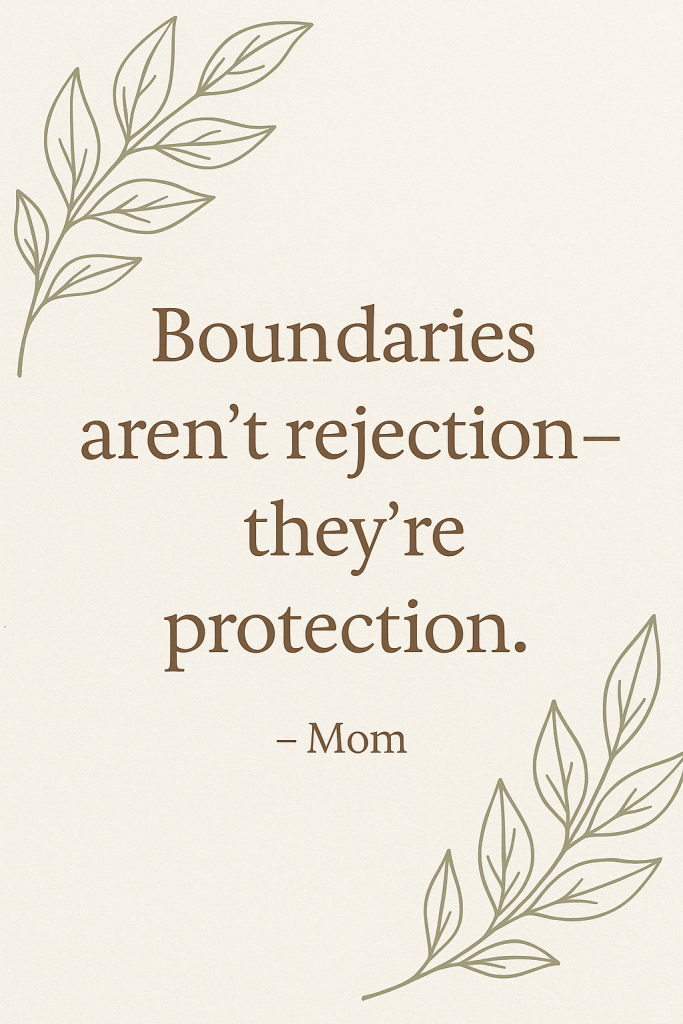
My mom taught me that boundaries are not about rejection; they’re about protection. Just like she didn’t hate that fly (well, not personally), she didn’t want it buzzing in her ear or walking across her sandwich.
The same goes for people. We can love them, care about them, and still need space from them sometimes.
What Do You Say?
Do you have a gentle but firm way to tell people to scoot? Have you ever struggled with setting personal boundaries? I’d love to hear your tips, stories, or wisdom that have been passed down from your own family.
Honesty is the best policy. Always be clear in your intensions when interacting with others.
I am reminded of when some people I met in passing, a couple, invited me to visit their home for the afternoon. I had recently moved into the neighborhood. I had not started my new job and had not met anyone in town yet. They were friendly people and wanted to extend their friendship to me. I accepted the invitation to spend the afternoon with them. We had a great time. We shared appetizers and enjoyed a very fine bottle of wine. At some point, I glanced down at my watch and noticed it was approaching 5:00 P.M. In my mind, that meant it would soon be dinnertime, and I felt I should leave so the couple could start preparing dinner.
I thanked them for a beautiful time, and just as I was standing, the wife said, “No, please, sit. Stay a while longer.”
“Oh, thank you,” I said, “It’s almost dinnertime, and I really should be going.”
“No, please,” the husband said, “Join us for dinner.” And, the husband looked at his wife for confirmation.
The wife confirmed with a resounding, “Yes. Please stay.” She continued, “I have a nice beef stew cooking in the crockpot, and I already made cornbread for dinner, so there is plenty of food for all of us.”
With that, we moved into the dining room. The husband graciously pulled out a chair for me to sit and he poured a glass of wine for me to enjoy while he and his wife went into the kitchen to prepare dinner.
But here is where the story gets sticky.
I overheard the wife ask her husband, “Why is she still here?”
To which her husband replied, “Well, you invited her, dear.”
“She’s eating up all of our food!” The wife made it sound like I was an uninvited guest.
At that point, it was a little bit awkward for me. After hearing the couple’s conversation, I wanted to change my mind about dinner, but before I could say anything, the husband entered the dining room and set out the dining wear. Following him, the wife arrived with a tray that held a large serving bowl of the beef stew. She retreated back to the kitchen and then returned with a little basket of cornbread. The husband said grace. Afterward, I served myself a small portion of stew and half a serving of cornbread. After all, I didn’t want to eat up all of their food.
Can you imagine what was going on in my head during that meal? I sat wondering where I might have misunderstood the wife’s invitation. I asked myself whether she genuinely invited me to dinner or pretended to be polite in asking, and I should have been polite in declining the offer.
Before I could take my last bite of food, the husband proceeded to pour another glass of wine, but I opted for a glass of water instead. I was preparing for my exit and did not want to be rude by leaving a freshly poured glass of wine, and much worse, eating and leaving too quickly, as social norms dictate that we should not eat and run. Nevertheless, the tension in my head was mounting. I could not wait any longer to get out of that house. And so, by social principles, I probably egressed too soon because after taking a couple of sips of water, I rudely glanced down at my watch, made up some phony excuse for leaving, stood up, and tried to sound as gracious as I could as I headed toward the front door to leave.
Where am I going with this story?
I think I am telling this story to say that confusion sets in, and feelings get hurt when we are not clear with our intentions. When unambiguously this couple invited me to dinner, they actually wanted me to leave. When I made a motion to go, they should have allowed me to leave. Instead, they encouraged me to overstay my welcome. I do not believe they intended for me to overhear their little kitchen conversation, and I do not think they intended to hurt me. I think their ultimate goal was to make me feel like they were overly hospitable entertainers. On the other hand, I should have been mindful of their time and left when I felt my time was up.
Let your yes be yes
The bible teaches us much about being forthright and sincere. It teaches us that we should refrain from lying or being deceitful.
The Lord asks us to live a life of honesty when dealing with our spouses, children, workmates, neighbors, in essence, all people with which we come in contact.
Scriptures about being forthright
The following scriptures are from the New International Version (NIV) unless otherwise stated.
Proverbs 24:26 26 An honest answer is like a kiss on the lips.
Matthew 5:37 37 “Simply let your ‘Yes’ be ‘Yes,’ and your ‘No,’ be ‘No’; anything beyond this comes from the evil one.
1 John 3:18 18 Dear children, let us not love with words or tongue but with actions and in truth.
Proverbs 6:16-19 16 There are six things the Lord hates, seven that are detestable to him: 17 haughty eyes, a lying tongue, hands that shed innocent blood, 18 a heart that devises wicked schemes, feet that are quick to rush into evil, 19 a false witness who pours out lies and a man who stirs up dissension among brothers.
Matthew 7:16 16 By their fruit you will recognize them. Do people pick grapes from thornbushes, or figs from thistles?
Ecclesiastes 7:20-22 (Good News Translation) 20 There is no one on earth who does what is right all the time and never makes a mistake.21 Don’t pay attention to everything people say—you may hear your servant insulting you, 22and you know yourself that you have insulted other people many times.
Keep it real
It is a fact that none of us are perfect. We quickly and easily slip into sin, sometimes before we are even aware of it. We all sin, and, thankfully, we are saved by the great, forever grace of God.
Being dishonest is a sin.
That couple who invited me to stay for dinner should have been forthright and clear in their intentions. If they did not want me to stay for dinner, they should not have invited me. And, truthfully, I should have been more honest too. I should have just gone home like I wanted to. My inner voice told me to leave, and if I had been honest with myself, if I had been honest about how I truly felt, then goodwill would have served all.
I will try harder to listen to my inner voice, which frequently when the voice speaks for good, how amazing it is that it tends to be the voice of God.
My dear friends, for a life filled with goodness and peace, it is wise to stay real, stay honest, and stay in the word of God.
Always remember that when you fall short of your goal to live upright, our God is a loving and forgiving God. Take your shortcomings to the Lord. Ask Him for forgiveness, and God will give you forgiveness without hesitation. And just like that, your inequities are wiped away, and you are as good as new.
May you walk in righteousness, knowing you serve the most powerful and mighty God of the world.





 Voice of Hope by Marlene